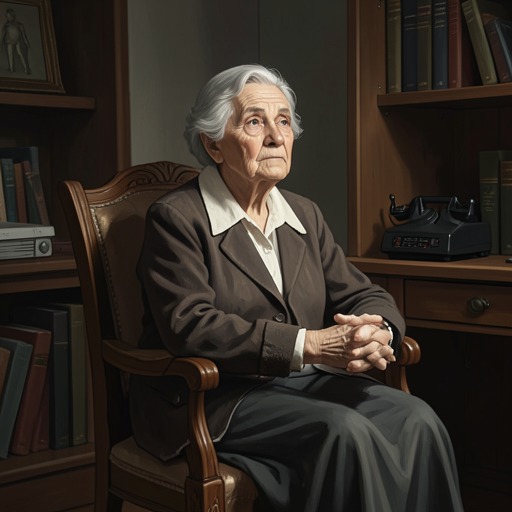
Elizabeth’s appointment diary
The Thursday Murder ClubElizabeth’s appointment diary is both a practical record and a carefully timed test of her memory. Each day she writes a question for herself two weeks ahead, then answers a question written a fortnight earlier. The routine makes the diary an early-warning system in a community where forgetfulness is a persistent fear, while its entries also preserve details relevant to the investigation of Tony Curran’s death.
A diary turned into a test
The ritual is structured around a delay. Elizabeth opens the diary at a date two weeks in the future and writes a question; each day, she also answers the question she set two weeks before. The interval matters: rather than testing immediate attention or rewarding a guess, the method asks whether a detail has remained accessible over time. Its recurring schedule gives Elizabeth a personal measure to compare from day to day, although the evidence does not suggest that she treats the result as a diagnosis.
The diary’s questions are designed to demand specific recall. Elizabeth rejects questions that could be answered by guessing or by remembering a broad category. In one test she asks for the registration number of a car connected to Gwen Talbot’s daughter-in-law. The question is deliberately narrower than asking the car’s make or colour: it requires her to retrieve a precise sequence of characters. The diary thus records not simply information but the standard by which Elizabeth chooses to examine herself.
The registration-number entry
One evening, as the village lights are going out, Elizabeth attempts that test. She shuts her eyes and focuses on the registration number. The answer comes to her as something she can see, or perhaps hear; the passage leaves that distinction unresolved, describing the recall as both. She writes the number, JL17 BCH, and checks it against the answer she recorded on the page. She is correct, and the result pleases her enough to close the diary for the day.
The entry is concrete in a way that matters to the test: success rests on retrieving the exact registration, not merely recognizing the vehicle. A related lapse is treated differently. Elizabeth has met the car’s owner only once and did not catch her name. She is confident that this was a hearing issue rather than a failure of memory. The diary’s system can provide a right-or-wrong comparison for a chosen fact; the name she missed offers no such certainty. That contrast shows both the usefulness and the limits of her self-monitoring.
Memory as a source of fear
The diary’s repeated questions take shape against a broader anxiety at Coopers Chase. Memory loss is described as a fear that shadows the community: ordinary lapses can prompt jokes from younger relatives, but they can also lead to private dread about losing independence and a sense of self. Elizabeth’s routine gives that diffuse fear a form she can act upon. Instead of waiting for uncertainty to become unmistakable, she creates a test whose results she can check.
That concern is present in her life with Stephen as well. After Elizabeth has been away with Joyce, Stephen talks about Emily as though she were his daughter and wishes she would visit more often. Emily was in fact Stephen’s first wife, who died nearly twenty-five years earlier; Stephen has no children. The diary is not presented as a remedy for his confusion, and Elizabeth’s own questions do not establish what is happening to him. The juxtaposition nevertheless places her deliberate monitoring beside a more painful instance of memory and the past intruding on the present. Her attention to the diary’s result, and her care for Stephen, give the test an emotional context without turning it into a cure.
Questions that hold two kinds of knowledge
The diary also takes in facts from the Thursday Murder Club’s work. After learning information from Joanna, Elizabeth writes a question asking how much money Ian Ventham made from Tony Curran’s death, then records the answer: £12.25 million. The information is both an investigative detail and material for a future memory test. A fact gathered in the course of the case is converted into a question that Elizabeth will answer later, binding the club’s inquiry to the diary’s private routine.
This use distinguishes Elizabeth’s diary from Joyce’s account of joining the Thursday Murder Club. Joyce begins writing about the club after attending her first meeting, making the investigation a subject for narration; Elizabeth’s appointment diary repeatedly turns selected knowledge into a test. Together, these forms place record-keeping in two different roles: Joyce writes to describe an experience, while Elizabeth uses dates, questions, and checked answers to assess recall. The diary’s significance lies in that double function. It is a modest everyday object, but its two-week structure lets Elizabeth confront the fear of forgetting while continuing to collect and retain the facts on which the investigation depends.